
History of Pointillism
Dots of colour spread across a page, bright, luminous colours and playful depictions of French life – Pointillism was an art movement built on colour contrasts. The Pointillist movement took colour to the next level. Using scientific theory, they built on the work of the Impressionists to develop a style that was as technical as it was riotous.
In this article we’ll look at Pointillism in more detail, considering the inspirations for the movement and the key figures that pushed the style forward. We will also explore the ways in which the effects of the Pointillist movement can still be recognised in many artists’ work today.
What is Pointillism?
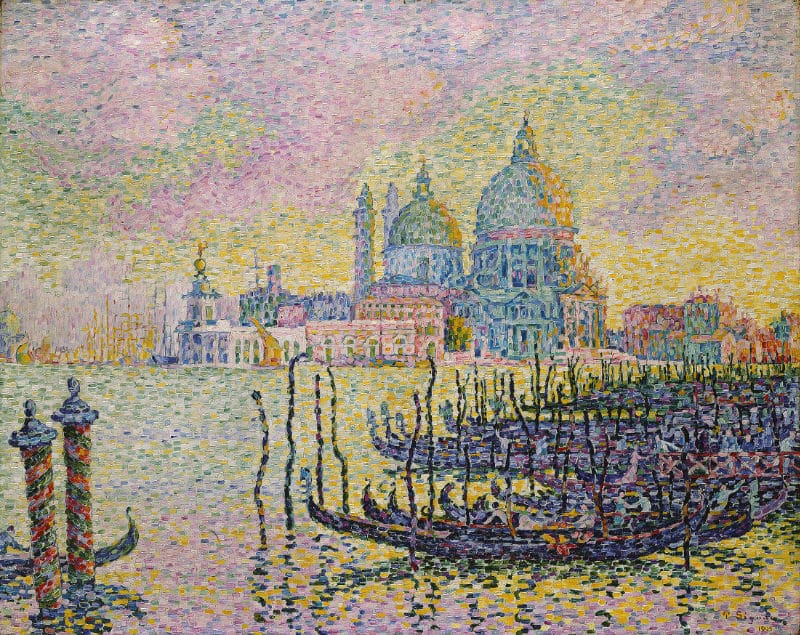
Pointillism is the name used to describe an art movement that began in the 19th century in response to Impressionism. Building on the short, loose brushwork of the Impressionist painters, the Pointillists built their paintings up using tiny dots laid in precise patterns. These dots utilized pure, unmixed colour that blended and juxtaposed with one another when viewed with the human eye from a distance. This optical effect gave the impression of vivid blocks of colour on the canvas, whilst also creating a sense of movement and life.
Pointillism was built on scientific theories of colour, including simultaneous contrast and optical mixing. Georges Seurat, the most famous of the Pointillist artists, studied the work of scientists Michel-Eugène Chevreul, Charles Henry, and Ogden Rood in detail to inform his new method. You can read more about these concepts HERE. The movement carried on until the early 1900s when the avant-garde switched to Cubism and other styles.
Pointillism was also known as divisionism and chromo-luminarism. The term ‘Pointillism’ was originally the name given to the movement by a critic, intending to insult the artworks. It was rejected by the artists who gave rise to the movement but nevertheless, it prevailed. Pointillism is no longer considered a derogatory term for these artworks but some scholars today still deem it to be incorrect.
Defining Neo-Impressionism
Pointillism was one aspect of what is now known as Neo-Impressionism. This term was used to describe one branch of the so-called Post-Impressionist artists who developed their art beyond the techniques characteristic of the Impressionist movement, from around 1886 onwards.
1886 marked the last of the Impressionist exhibitions which had run since 1874. From that point onwards, the dominant artists were largely considered to be Post-Impressionist. This included Paul Cézanne, Paul Gauguin and the Neo-Impressionists Georges Seurat and Paul Signac. Vincent Van Gogh is also considered to be a Neo-Impressionist painter. The Post-Impressionists were generally less concerned with naturalistic light and colour, focussing more on structure and order.
The Neo-Impressionist artists took colour theory to the extremes in their works, using different colours to connote light and form. Van Gogh is known for his garish and intensely hued paintings that use contrasting colours side by side. Meanwhile, Seurat and Signac are credited with the Pointillist movement and the minute detail of their dotted method.
Unlike Impressionism, which favoured spontaneous movement and quick paintings often made outside ‘en plein air’, Pointillism required extensive pre-planning. In order to create the effect of the individual spots that added up to a complete image, a great number of studies were needed before the final painting could be begun. This painstaking technique set it apart from the free brushwork of the Impressionist artists. It also meant that the style only appealed to artists who had a lot of patience!
The Beginnings of Pointillism
Whilst Pointillism is considered to be a distinct art movement, set apart from Impressionism, it did not appear from nowhere. It had its roots firmly in the Impressionist moment and some of the most prominent figures among the Impressionists laid the foundations for Pointillism to develop.
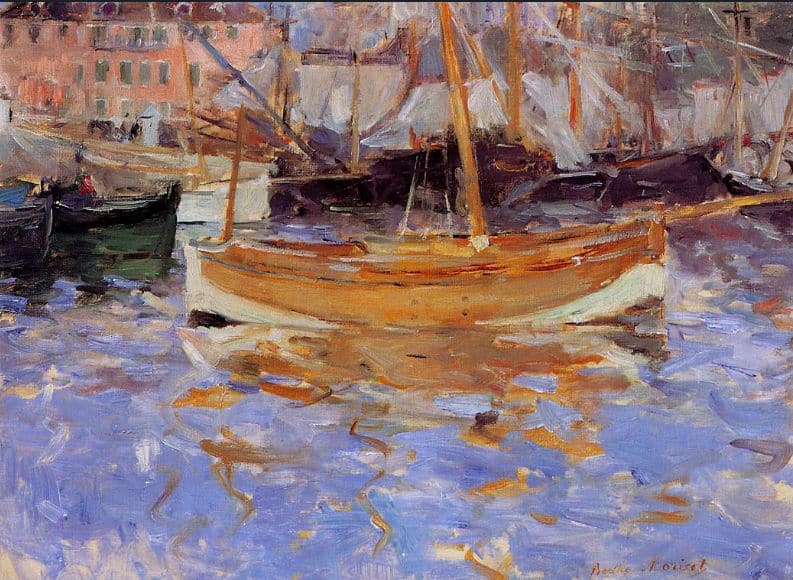
This is evident from paintings such as Berthe Morisot’s ‘The Harbour at Nice’ from 1881-82. In this work, Morisot uses short, loose brushstrokes to layer up contrasting colours in her painting. This has the effect of lending the colours greater vibrancy. The brightness of her palette and the way she plays with the reflections on the water create a bold scene that brings to life the energy of a harbour at midday. This painting foretells the colour affects to come in the works of Seurat and Van Gogh.
Key Artists in the Pointillist Movement
Georges Seurat
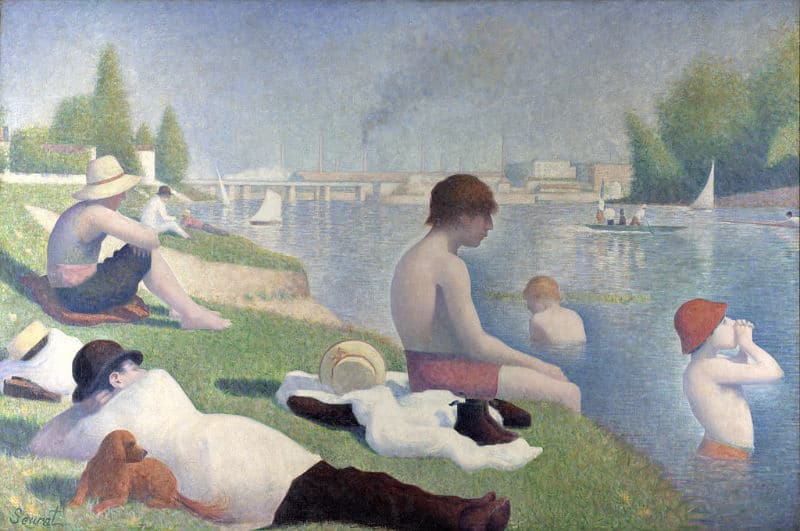
Georges Seurat was the first of the Pointillist or Divisionist artists. The emergence of the movement is largely considered to have begun in 1886 but many of his works were moving towards the Pointillist style before then.
He pioneered the new and courageous technique, which he insisted was firmly grounded in scientific theory. In doing so, he sought to distinguish his works from the Impressionists by championing scientific method above all else. His innovative style quickly won him recognition in the Parisian art scene and he became known as one of the leaders of the French avant-garde.
One of his earliest paintings ‘Bathers at Asnières’ from 1884 was the first canvas that showed the direction Seurat’s colour obsession would take. This painting mirrors the Impressionist style of painting outdoors, in natural light, but has none of the fleeting spontaneity that is characteristic of the movement. Instead, Seurat uses careful mixing of different colour hues in a nod to Eugene Delacroix’s work. The effect is dreamy and gentle but get closer to the work and you can see the buzzing brushwork.
Seurat died suddenly at the age of just 31 as a result of diphtheria. Consequently, Paul Signac took over as the head of the Neo-Impressionist moment from 1891 onwards. Seurat’s legacy lives on in his Pointillist works, however, which still stand as some of the most impressive and best-known examples of the movement. Similarly, he inspired artists like Vincent Van Gogh and other Post-Impressionists and is now considered an icon, merging between the rigours of science and the poetry of art.
Paul Signac
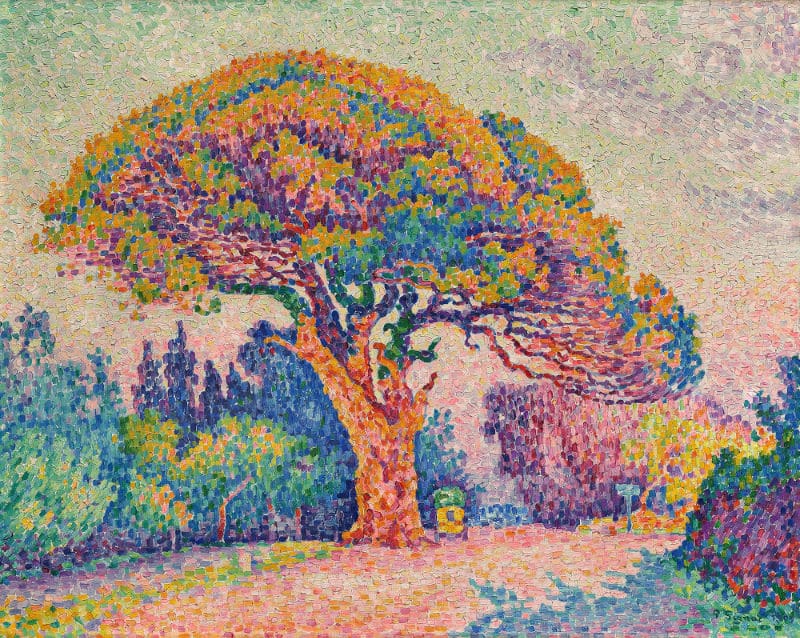
Paul Signac worked closely with Georges Seurat whilst he was alive and the two artists developed their technique side by side. In his Pointillist works, Signac sought to depict working-class life. This is evident in paintings such as ‘The Milliner’ from 1885 in which he shows the tradesmen behind the more glamorous aristocratic subjects that were common to many of the Impressionists. In this particular example, it is two women working in Paris’ garment district.
Signac liked to refer to the Pointillist technique as a kind of music or harmony and he described his process as like a composer considering each instrument when building up a symphony. He used optical mixing techniques, ‘melange optique’ in French, which drew on the work of colour theorists to create visually poetic artworks.
As well as painting, Signac also experimented with other mediums including watercolour, etching and pen-and-ink. In all these forms, he continued with the idea of using dots and indefinite lines. He created forms without lines in order to create abstract pieces such as the black and white ‘The Dining Room’ from 1886-87. This piece is composed entirely of black dots made from graphite and ink on paper and the ways in which he created tone through pinpoints is most obvious in this medium.
In his later works, he began to experiment with ever more vibrant colour palettes, as well as a wider spectrum of colours. His dots become less meticulously applied to the canvas and instead his works are more expressive. They are infinitely more romantic than the rigidity of the earliest Pointillist styles and show the progression that the movement would take towards Fauvism later on.
Camille Pissarro
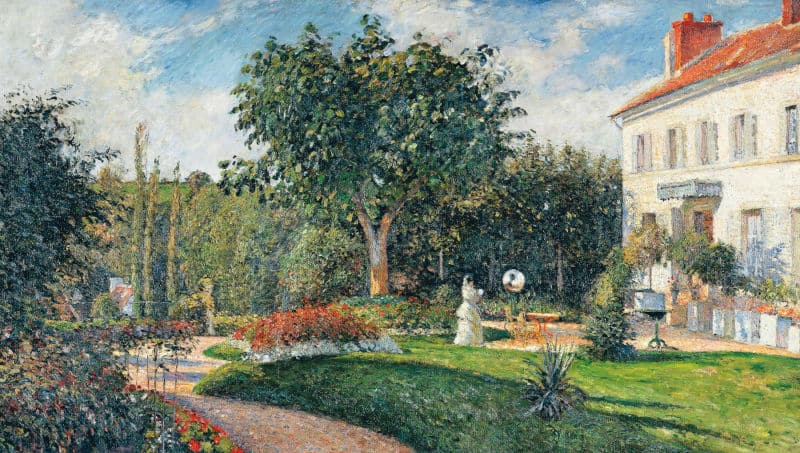
Camille Pissarro was not one of the ‘inventors’ of Pointillism but his adoption of the style had an effect on further promoting and popularising the movement. Pissarro experimented with Pointillist techniques from 1885 to 1888 as a way of innovating his artworks in order to keep them fresh. He took a gamble on the technique on the advice of his son, Lucien, who greatly admired the works of Seurat and Signac.
Pissarro took Pointillist styles and blended them with his focus on everyday peasant life, using the same colour theories to create vibrant works that brought his rural scenes into sharp, brilliant relief. His work shows a gradual progression towards the Pointillist style as his brushstrokes became ever shorter and his colours brighter. This can be seen in works like ‘Haymaking’ from 1887. Some of his most impressive works from this time include ‘Apple Harvest’ from 1888.
The movement drove Pissarro to paint in a way that was completely new to him. He had previously favoured speed and freedom in his paintings, often capturing the faces of his subjects in under an hour. In contrast, Pointillism forced him to conduct extensive planning and pre-studies before beginning a final piece.
Pissarro’s influence in the Impressionist Exhibitions enabled him to convince the other artists to allow his paintings and those by Seurat, Signac and Lucien Pissarro to be shown in a separate room. This set their work apart from the other Impressionist paintings and firmly established the movement as a distinct style to be appreciated in its own right.
He eventually gave up on the art movement, finding the style too restrictive for his tastes. Nonetheless, Pointillism influenced his artworks for the rest of his life. He continued to use the theories of contrasting colours in his compositions and smaller, sharper brushstrokes compared to his earlier paintings.
How Did Pointillism Inspire Other Artists?
Arguably the most important artists to arise from the Pointillists’ legacy were Vincent Van Gogh and Henri Matisse. These artists embraced the movement’s colour theories but shaped them into their own, distinct styles.
Van Gogh knew Seurat and Signac from Paris, where he lived from 1886 to 1888. Similarly, he was influenced by his frendship with Pissarro. Van Gogh experimented with Pointillism and some of his paintings clearly show a Pointillist-inspired style such as ‘Self-Portrait’ from 1887. However, he did not use the same meticulous technique of the Pointillists, preferring a more free-hand approach.
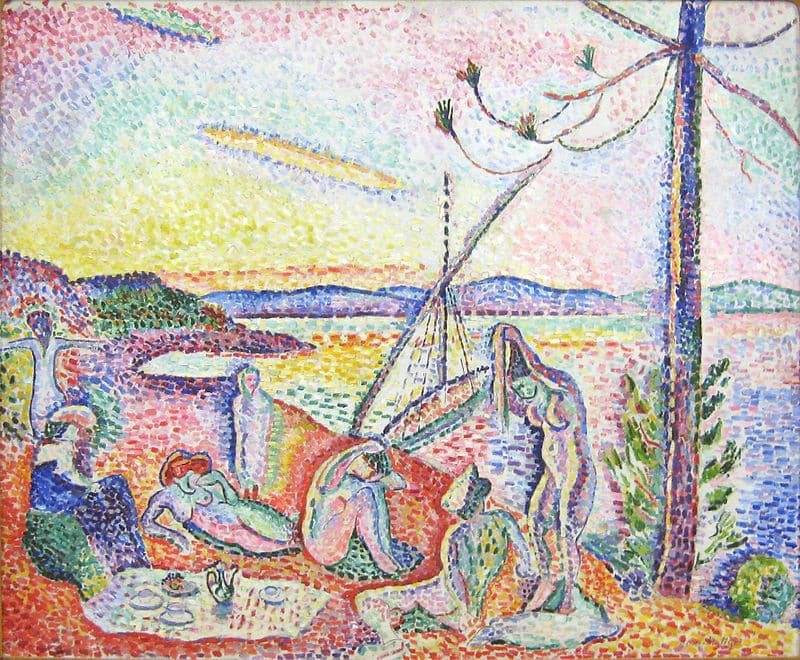
This particular piece has been credited with paving the way to Fauvism, bridging the gap between the two movements. Fauvism took off during the 20th century, inspired by the works of Seurat and Van Gogh, as well as other Post-Impressionists. Matisse is generally considered to be the leader of the Fauvist movement that was characterised by intense, pure colour used to denote light and space.
Much later, the Pop Art movement can also be understood to have taken inspiration from Pointillism. Most notably, the works by Roy Lichtenstein built up colour using distinct dots to create eye-catching and bold compositions. Whilst they look ready made and even mechanised, he made the works by hand, painstakingly drawing, tracing and painting the works as his Pointillist forebears did. Much of Lichtenstein’s later works include nude female figures where he contrasts the lines of the women’s bodies with the strict geometry of his dotted compositions.
Pointillism Today
Pointillism continues to thrive well beyond its 19th-century origins. Contemporary artists still draw upon the core ideas developed by Seurat and Signac – building images from individual marks, exploring optical blending, and allowing colour relationships to create vibration and depth. While the materials and contexts have expanded dramatically, the distinctive dotted aesthetic remains instantly recognisable.
Modern interpretations appear across an extraordinary range of mediums. Traditional painters experiment with acrylics, ink, and watercolour, while illustrators produce intricate stippled drawings using fineliners or felt tip pens, achieving tonal variation through dot density rather than line. Street artists and muralists create vast walls of sprayed dots that shimmer into gradients when viewed from afar, echoing the optical effects of classical Pointillism but with a bold, urban presence.
Digital art has proven a natural home for Pointillist thinking. Pixels function as the contemporary equivalent of painted dots, enabling artists and designers to manipulate colour clusters, noise patterns, and halftone textures. These works often play with perception, scale, and resolution, reinforcing the same visual principle: discrete units merging into coherent form at viewing distance.
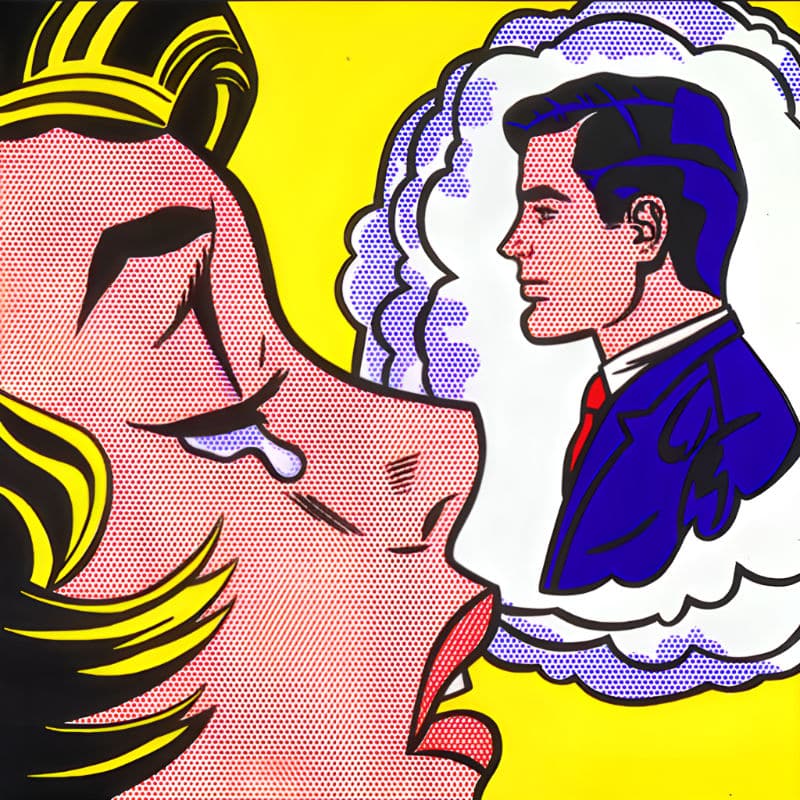
Several influential artists reflect Pointillist-inspired approaches:
Yayoi Kusama – Renowned for immersive environments and artworks structured around repeating dots, transforming the motif into a psychological and spatial experience.
Chuck Close – Constructed monumental portraits from grids of small colour units, where abstraction up close resolves into realism at a distance.
Damien Hirst – Explored colour interaction and visual rhythm through systematic spot paintings.
Roy Lichtenstein – Adapted Ben-Day dots from commercial printing into fine art, using them for shading, texture, and visual drama.
These diverse practices demonstrate how Pointillism’s principles have been continually reinterpreted rather than rigidly preserved. Some artists pursue painstaking micro-dot precision, while others embrace oversized, expressive marks for graphic impact. The technique now serves both as a study in patience and control, and as a playful vehicle for stylistic experimentation.
Give it a Go
Have a go at creating your own Pointillist-inspired piece. You might:
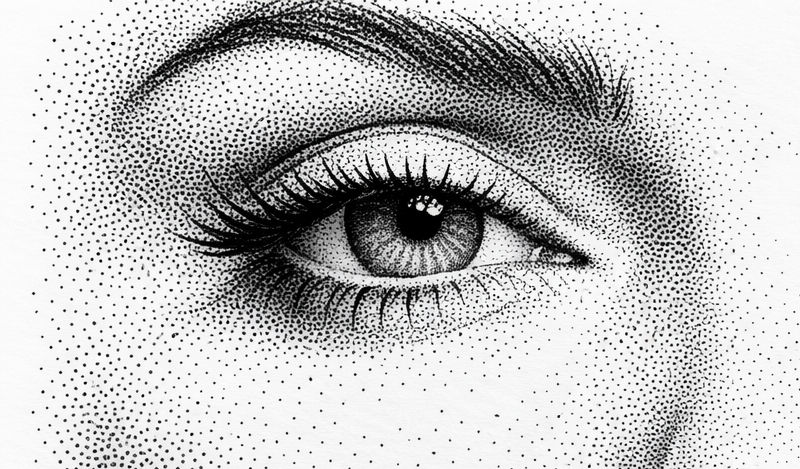
- Build a monochrome drawing entirely from pen dots
- Experiment with complementary colour dots for optical vibration
- Try large, painterly dots for a bold contemporary look
- Recreate a simple landscape or portrait using stippling
Whether you prefer precision or expressive freedom, the appeal of Pointillism lies in its magical illusion: chaos up close, harmony from afar. Create up close then stand back often to see the effect.
Why not follow our tutorial video on how to paint using pointillism