20 Drawing Mistakes
You’re Probably Making
Most drawings do not fail because of lack of talent. They fail because of small structural mistakes the artist never learned to see.
The encouraging part is this: once you become aware of these issues, they are usually simple to correct.
There is no shortcut to excellence. Practice matters. But practising the wrong thing only reinforces bad habits. The goal is not just to draw more, but to draw with awareness.
Here are 20 easily overlooked "don'ts" that can instantly strengthen your work.
1. Don't Ignore the Shape of Your Paper
Your paper or canvas is a shape, usually a rectangle. That rectangle is the first shape in your drawing.
Every element you place must relate to that frame.
One of your first decisions is where to place the horizon line. Avoid placing it in the middle.

If you have foreground, middle ground and background, avoid giving them equal space. Here you can see how I have placed the horizon just below the centre point. The land has less space than the mountains and the mountains have less space than the sky. This keeps the composition interesting.
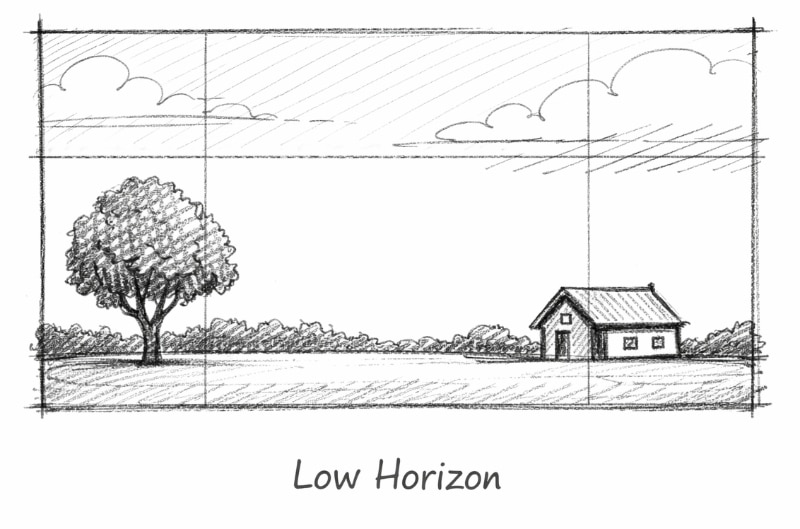
If the sky is your focus, place the horizon lower, roughly one third up.
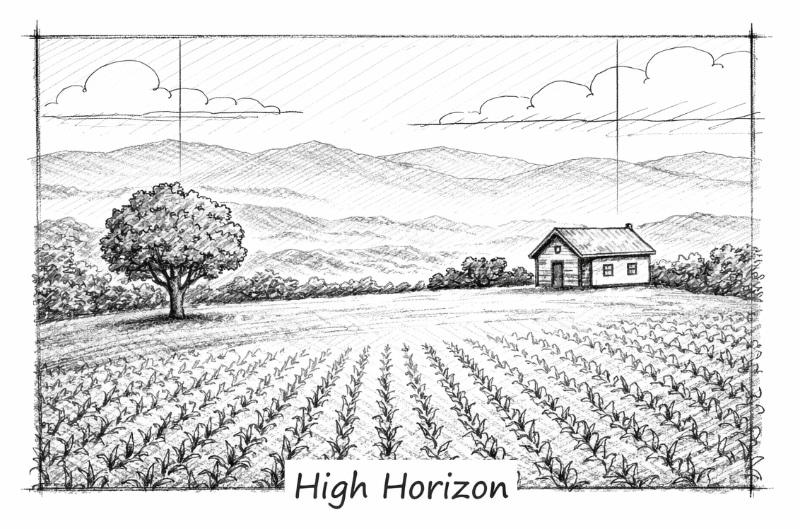
If the land is the focus, move the horizon closer to the upper third.
Even in portrait drawing, your eye level affects perspective.
2. Don't Crop Symmetrical Objects in Half
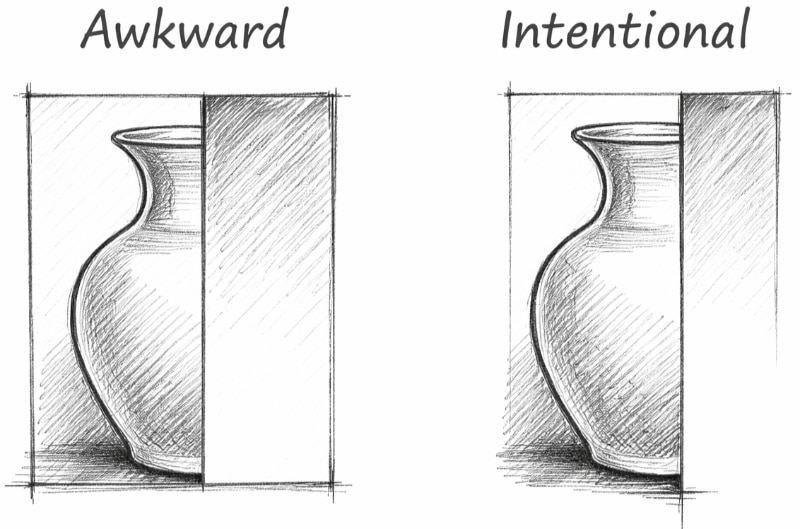
Cropping is powerful when intentional.
If you cut a symmetrical object exactly in half at the frame edge (or when being overlapped by another object), it looks awkward.
It’s acceptable to crop off a bit, or even a lot, but don’t crop on the halfway point. An off -centre crop leads the viewer to believe the object carries on outside the confines of the frame; but cropping halfway looks odd.
Also don’t crop at a joint in the case of living being or at the corner of a structure.
If an object in your drawing just touches the edge of the frame, then make it bigger and crop a bit off or make is smaller to allow for a space between it and the frame.
3. Leave Looking Room
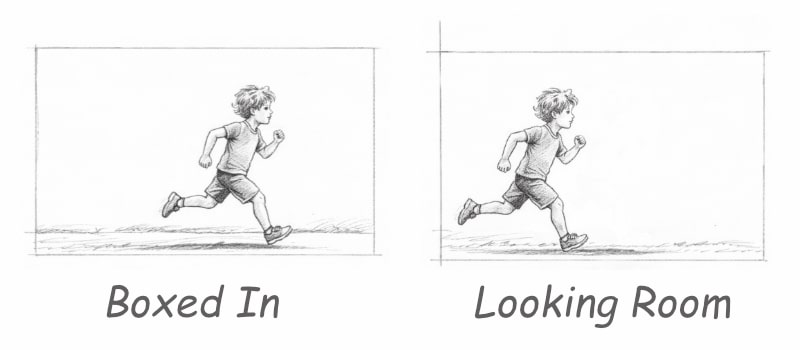
If something implies movement – a running figure, a car, even a gaze – give it space in the direction it’s moving or looking.
Crowding the front of a moving subject creates tension, and not the good kind.
Allow room for movement. Let the viewer feel that motion continues.
4. Don't Isolate a Corner
Avoid placing an object so it completely cuts off a corner of your drawing. That corner becomes visually blocked and disconnected from the rest of the image.
If you cannot reposition the object:
- Soften its edge
- Reduce its contrast
- Adjust its value so it recedes
Also consider this: in Western cultures, the viewer’s eye typically enters an image from the bottom left. You can use a shadow, a partial object, or even a subtle shape to guide the viewer’s eye toward your focal point.
5. Don't Give the Eye an Easy Exit
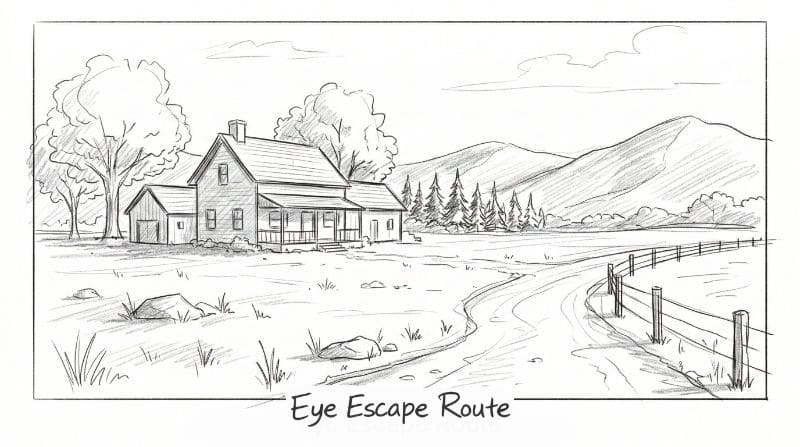
Don't give the viewer’s eye an easy escape route out of your drawing. Straight lines, either actual or implied, (especially diagonal lines), will encourage the viewer’s eye to move rapidly along them whereas curved lines tend to slow down the viewer’s eye and keep them in your picture for longer.
For this reason, avoid having a road or path exiting at the side of the artwork as the viewer’s eye will follow and be carried out of the picture.
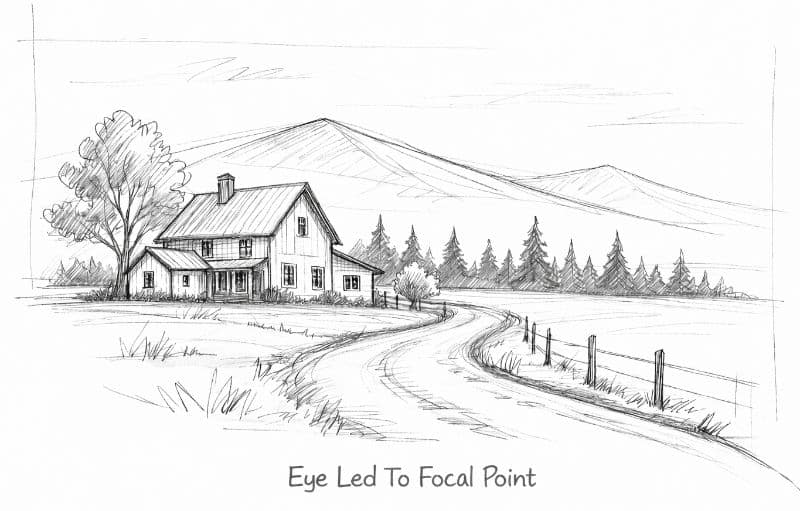
Here you can see how the eye is rather being led to the focal point as the eye follows the road.
If there is no alternative, then at least use some object like a tree, bush, lamp post etc., to block the eye from exiting.
If you have mountains in the background, make sure that where they exit the frame at the sides, the contour line is moving upwards and not downwards. Alternately you can also fade the lines away as I have done above.
Your aim must always be to keep the viewer inside your picture.
6. Don't Create "Kissing Edges"
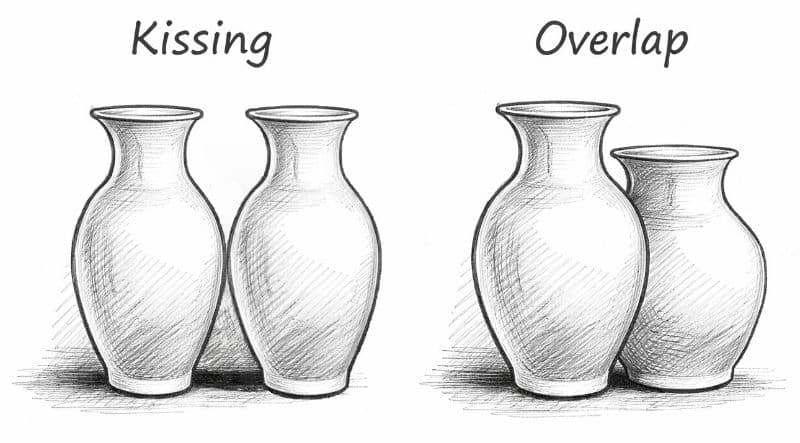
A kissing edge happens when two objects touch but do not overlap.
This creates visual tension and flattens space because it shows the objects are on the same plane. As artists we are trying to create the illusion of depth on a flat surface so kissing objects defeat the purpose.
Show depth by overlapping one object in front of the other, or by showing a clear gap between them.
7. Don't Allow Shared Edges
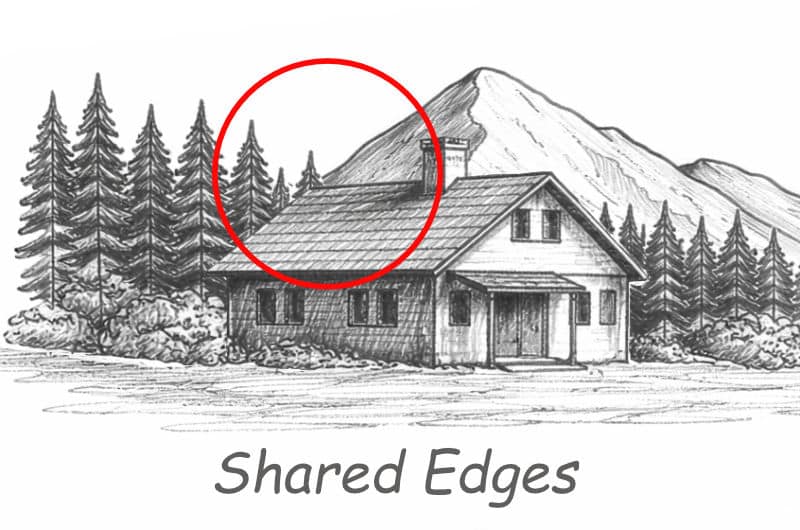
If a roofline perfectly aligns with a mountain ridge behind it, they appear fused together.
Move one slightly up or down.
Overlapping forms increases depth and makes your composition stronger.
8. Don't Forget About Perspective
Objects become:
- Smaller
- Lighter in value
- Less intense in colour
- Less detailed
as they move further away.
This applies to everything in the scene. Trees, people, buildings, clouds, ripples on water - Everything!
Even spacing changes. Ripples and cloud shapes compress as they recede.
Check scale carefully. Objects on the same plane must relate accurately to one another.
9. Don't Create "Monsters"
Be careful with vertical background elements like tree trunks, poles or chimneys.
If placed behind a foreground object, eg. a head, they can look like antlers or something growing out of the front object.
If you cannot move the back object you can :
- Reduce its contrast
- Lighten its values
- Push it back into the distance by making it smaller
This avoid the accidental comedy you sometimes see in artworks.
10. Don't Make Repetition Boring
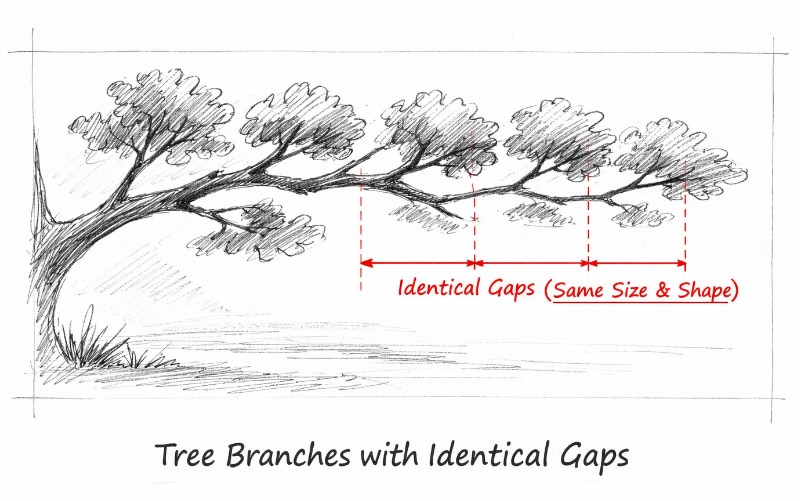
Nothing in nature repeats. Only man made objects do. As a result if you make two or more natural object repeat, they stand out like a sore thumb.
Look out for natural objects that are:
- The same height
- The same spacing
- The same value
- The same shape
and vary / modify / move them.
Nature is irregular. Your drawing should be too.
11. Don't Create Perfectly Symmetrical Organic Shapes
By the same token, be careful not to create symmetry in natural objects.
Trees and bushes divided into two identical halves feel unnatural.
The human eye finds asymmetry more interesting.
If you must include symmetrical architecture, break the symmetry in your composition by adding surrounding elements.
Balance does not mean mirroring two exact objects. Two asymmetrical objects look more more pleasing to the eye.
12. Don't Let Shapes & Angles Echo
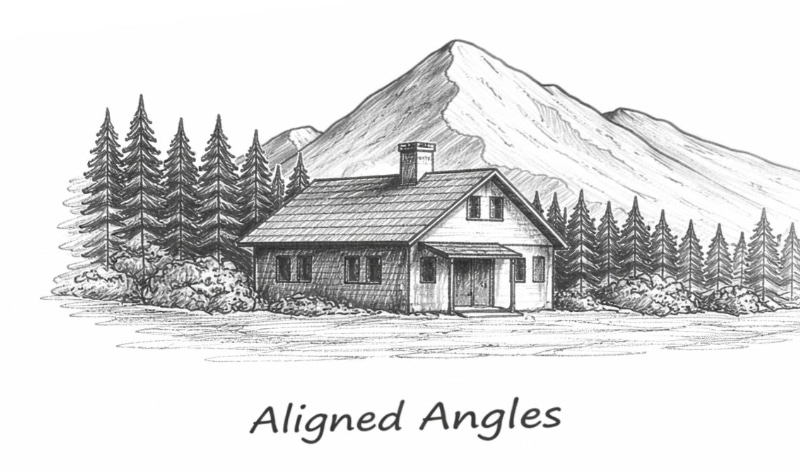
Don't inadvertently have shapes & angles echoing each other too closely, e.g. the shape of an object in the foreground echoed by an identically shape in the background behind it as the two will look strangely joined.
Vary them deliberately.
Subtle differences create depth and interest in your scene.
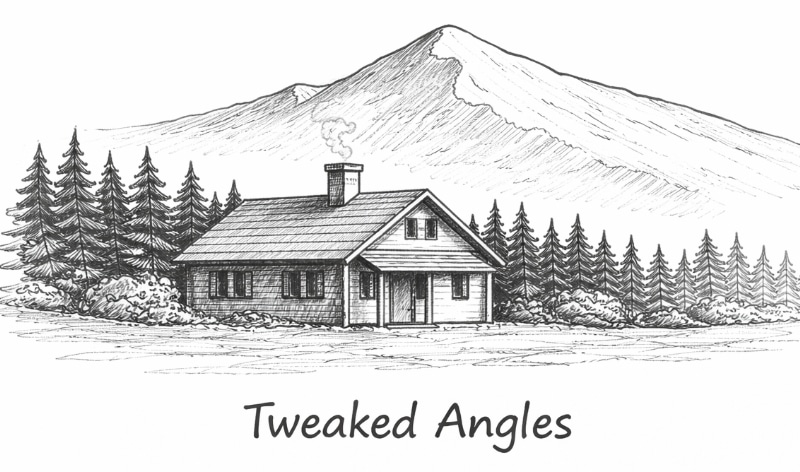
Here you can see how the shape of the mountain has been compressed to ensure the angle of the roof doesn't match anymore. As you can see, the mountain still looks like the same mountain, it just looks like we are viewing it from a different vantage point.
Want to go deeper into composition? Our tutorial on Mastering Art Composition explains how to design stronger layouts in your artworks.
13. Don't Create a Shared or Split Apex
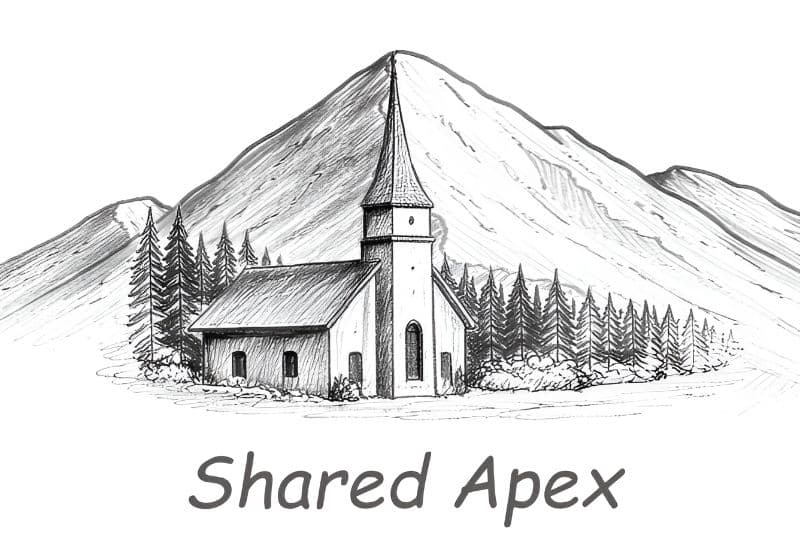
A shared apex happens when two strong vertical forms line up perfectly — for example, a church steeple directly in front of a mountain peak.
When their tops align, the symmetry feels awkward and accidental.
Shift one slightly left or right so the peaks no longer share the same point. Small adjustments can dramatically improve visual comfort.
14. Don't Hide Important Edges
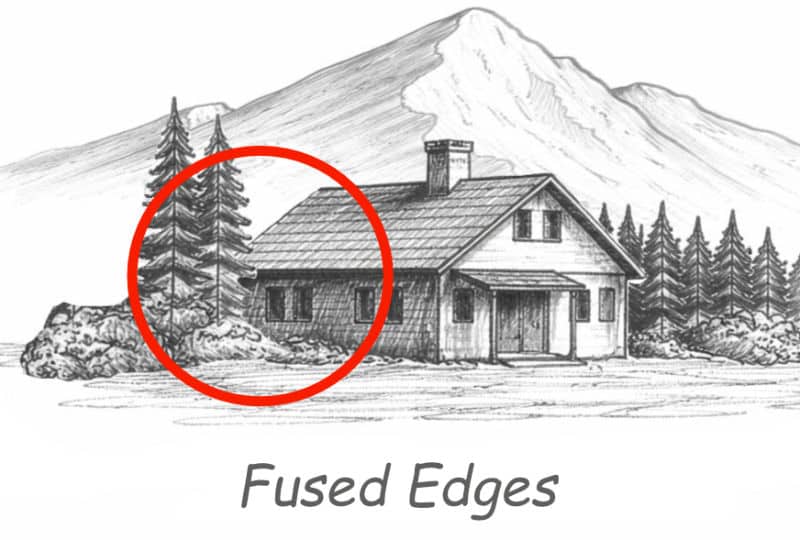
Don't have the edge of one object obscured by another. For example, the edge of a building hidden by an object, e.g. a tree, directly in front of it. This gives the weird feeling that there is no space between them, and they are fused.
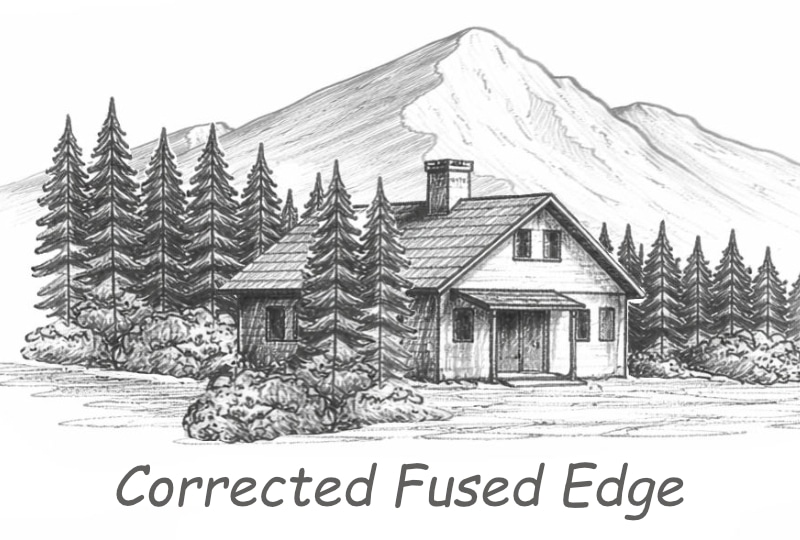
Move the tree so that the wall extends slightly behind the tree thus creating overlap and distance and shows the viewer that the items are on two different planes.
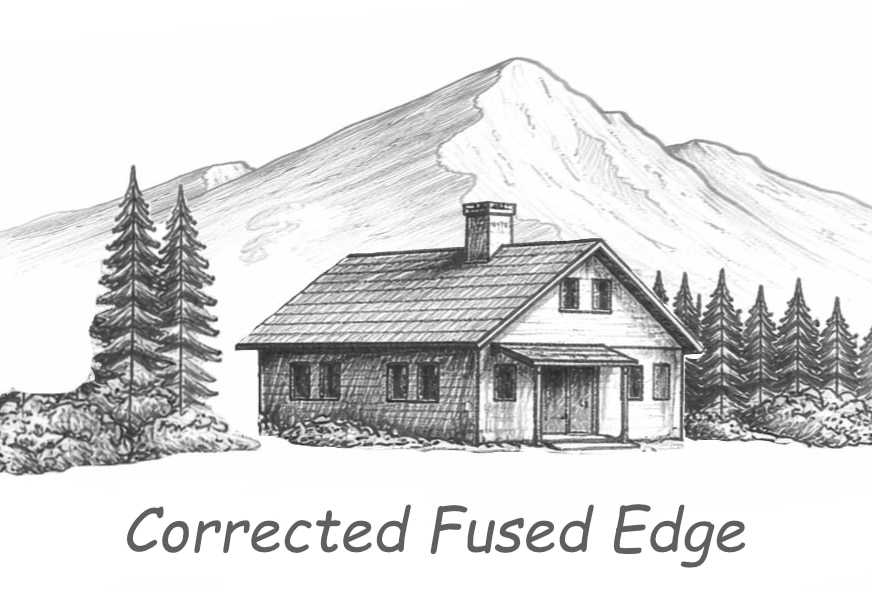
Alternatively leave a gap between the two objects if they belong on the same plane.
15. Don't Be Timid with Contrast
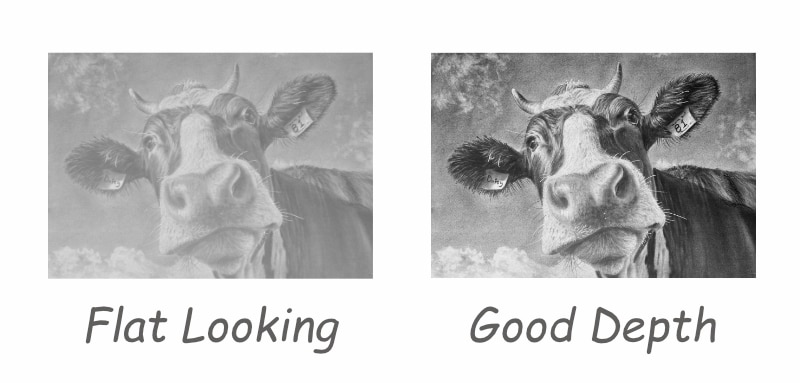
Don't be a wimp, use as much bold contrast as you can. Contrast gives life to your drawing.
Contrast can exist in:
- Value
- Size
- Texture
- Pattern
- Colour
Concentrate your strongest contrast around the focal point. If everything is equal, nothing stands out.
You will often hear me saying "You can't have bright lights without dark shadows" in my classes. You need the dark values to contrast against the light ones in order to make your highlights sparkle.
16. Know When To Work Accurately
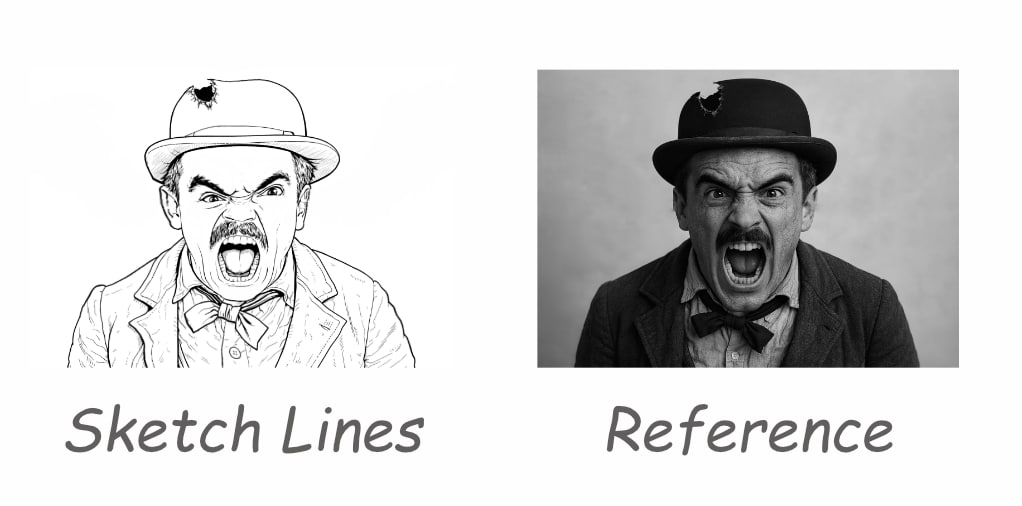
With many subjects it is important to work accurately. Take the sketch lines above as an example. I am sure you agree that although all the main features seen in the reference image have been sketched in, the sketch is not true to the reference.
If you had to go ahead and draw this portrait, it would not matter how perfectly you shade all the tonal values or how well you render all the textures. The final portrait would look like an entirely different person.
It is all good and well feeling all "artsy" and sketching your reference out free hand, but realise that in certain circumstances accuracy is more important.
Your final artwork can only look as good as your intial sketch work.
17. Don't Ignore Negative Spaces
Don't forget the negative spaces. Negative spaces are the spaces between objects. If they are too much the same, they will be boring to look at. For example, when drawing tree branches; make sure the negative spaces between them are all different. Also look at the negative spaces around the main objects in your artwork. They should all be unequal. If you have a large negative space e.g. a sky; try to break it up with clouds, trees etc. to make it interesting.
18. Don't Forget Shadows
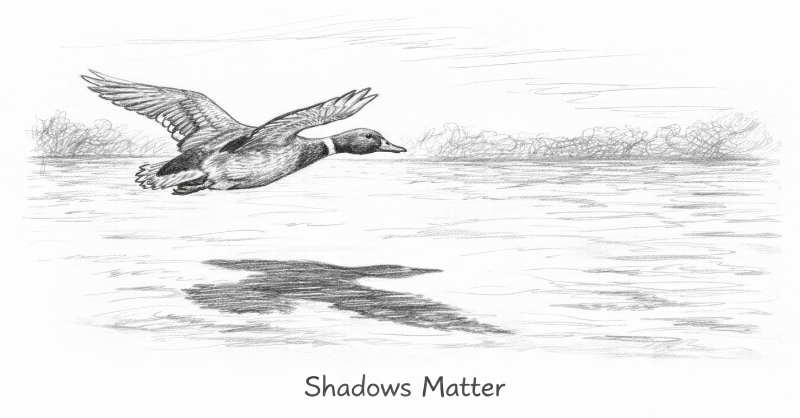
Shadows anchor your object and prevent it looking as if its floating.
The edges of shadows will depend on the type of lighting. In overcast or soft lighting, shadows will be soft edged. Harsh lighting results in hard-edged shadows.
Shadow edges are also darkest and most hard edged the closer they are to the object and fade lighter and softer as they recede away from the object.
Used cleverly shadows can not only show the direction of the light and the type of light source, they can show time of day and even indicate height off the ground as well as suggest movement.
19. Don't Confuse Your Light Source
Always be aware of what direction the light in your drawing is coming from. Shadows must all fall to the same side or your drawing will look “off”. Be especially careful when combining multiple images into a single composition. If the light source is on the opposite side in an image you want to use, try flipping it horizontally on your computer so the shadow falls to the correct side.
20. Don't Accidentally Draw Cartoons
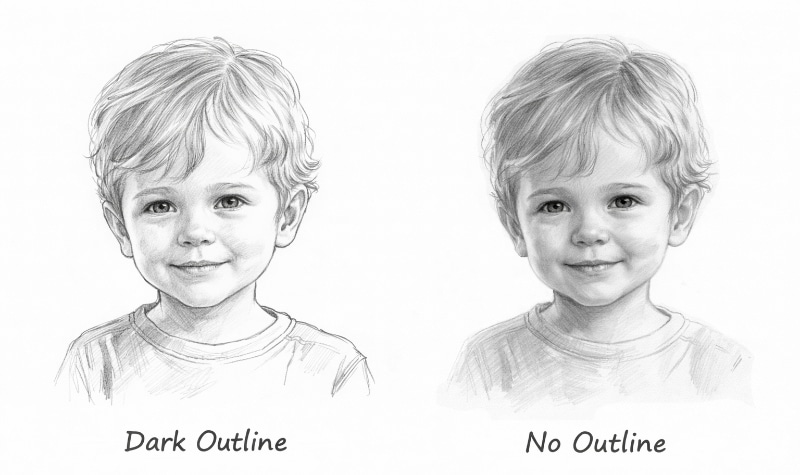
Drawings which are outlined look cartoonish. Be sure that when transferring your drawing to your paper, the contour lines are not too dark as this will determine how light you can go with your value. If for example, you are drawing a portrait of a child and want to use a very light value for the skin; you won’t be able to do this without leaving a cartoonish dark outline if your transfer lines are too dark.
Artists often forget that part of getting a realistic look in your drawings is having found AND lost lines.
Let tone define the form instead of heavy outlines and if a line or edge is meant to naturally disappear, so be it.
If you would like to improve your sketching skills you can follow my Sketching Basics Course.
Thank you for following the tutorial.
Pin Me